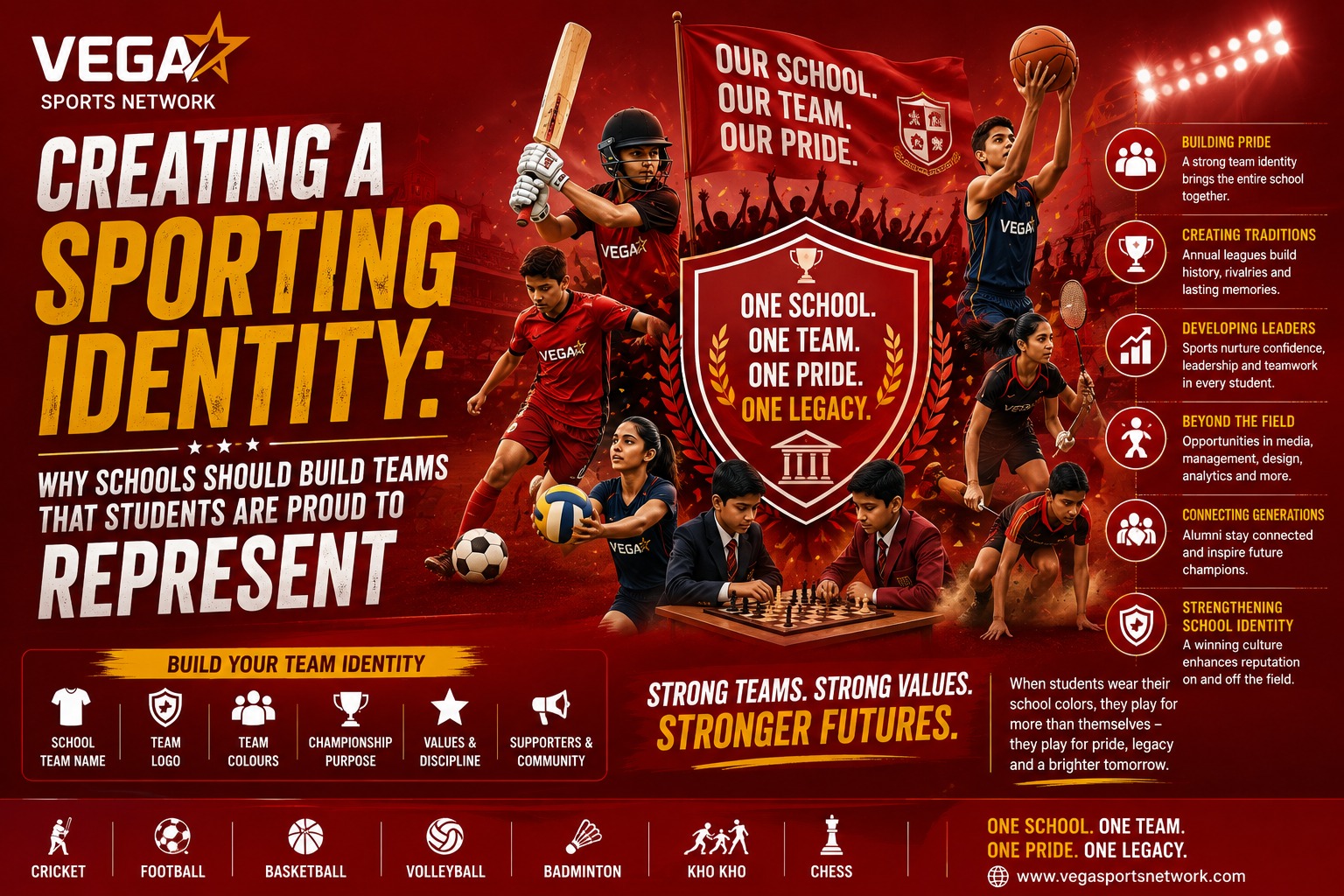
Ask former students about their school years and they may forget many ordinary days.
But they often remember the final of an inter-school tournament.
They remember wearing their school's jersey.
They remember classmates cheering from the sidelines.
They remember representing something larger than themselves.
This emotional connection is what creates a sporting identity.
For educational institutions, sports can become an important part of school culture—not simply as an extracurricular activity, but as a tradition that connects students, teachers, parents, alumni, and future generations.
A Team Represents More Than Its Players
When students represent their school in competition, they carry the identity of the institution onto the field.
The school's name appears on the jersey.
Its colours become symbols of pride.
Students who may not personally know the athletes still celebrate their achievements.
This creates belonging.
A successful school sports program therefore has an impact far beyond the participating players.
It gives the entire student community something to support.
Building a Recognizable Team Identity
Schools can strengthen this connection by developing distinctive sporting identities.
A team can have:
- Its own name
- Team colours
- A professionally designed logo
- Jerseys and uniforms
- A mascot
- A motto
- Supporter merchandise
- Social media identity
- Championship records
- Annual awards and traditions
Over time, these elements become part of the institution's sporting history.
Imagine students joining a school knowing that its cricket, basketball, football, volleyball, badminton, Kho Kho, or chess team has existed for many years.
That creates aspiration.
Young students begin dreaming of representing those teams when they become older.
Why Annual Leagues Matter
Sporting traditions require continuity.
A single tournament can create excitement for a few days.
An annual league creates history.
Every year produces another team.
Another captain.
Another championship.
Another group of outstanding performers.
Another chapter in the school's sporting story.
After five or ten years, the competition is no longer simply an event—it becomes an institution.
Students begin comparing teams across generations.
Records are created.
Rivalries develop.
Alumni return to support their former schools.
This is how sporting culture grows.
The Franchise Concept for Schools
One interesting development in organized school sports is the possibility of schools building their own permanent franchise identities.
Rather than assembling temporary teams for individual tournaments, institutions can establish recognizable franchises that participate across seasons.
The school retains its identity while developing a professional sporting brand around it.
For example, the same school could potentially operate teams across multiple disciplines under a common franchise identity.
This creates consistency and gives students something recognizable to represent.
Developing Leadership Through Team Ownership
A school sports franchise can also create opportunities beyond playing.
Students interested in media can help create match content.
Students interested in design can work on posters and graphics.
Students interested in journalism can write match reports.
Students interested in technology can help with statistics and scoring.
Students interested in business can learn about sponsorship, branding, and sports management.
This transforms sports into a broader educational experience.
Creating Healthy Inter-School Rivalries
Competition between schools can become extremely engaging when managed responsibly.
Healthy sporting rivalries encourage athletes to prepare better and generate enthusiasm among students and parents.
However, rivalry should always remain respectful.
The objective should be to compete intensely on the field while maintaining friendship and mutual respect away from competition.
When managed properly, annual inter-school leagues can build relationships between educational institutions rather than divide them.
Celebrating More Than Champions
A strong school sporting culture should recognize different forms of achievement.
Awards can celebrate:
Best Player.
Best Emerging Athlete.
Best Captain.
Best Goalkeeper.
Best Bowler.
Best Batter.
Best Defender.
Best Sportsmanship.
Most Improved Player.
Recognition encourages students to understand that contribution takes many forms.
Connecting Alumni Through Sports
Sport can also become a powerful connection between schools and their alumni.
Former students often retain strong emotional attachments to teams they once represented.
Schools can invite alumni to attend championship matches, mentor younger athletes, support teams, or participate in exhibition events.
This creates continuity between generations.
A student playing today becomes the supporter of tomorrow.
Sports Strengthen the Institution's Brand
Parents increasingly evaluate educational institutions not only by academics but also by the overall development opportunities available to students.
A strong sports program demonstrates commitment to fitness, leadership, teamwork, discipline, and student development.
Professional sporting participation can therefore strengthen an institution's overall reputation.
Photographs, tournament achievements, player stories, and championship records become valuable parts of the school's public identity.
Building the Next Generation of School Sports
Vega Sports Network believes that inter-school sports can evolve beyond occasional competitions into professionally structured annual leagues.
Our vision is to create platforms where participating schools can develop and own their individual team identities, compete annually, build sporting traditions, and provide students with memorable competitive experiences.
Across Cricket, Football, Basketball, Volleyball, Badminton, Kho Kho, Chess, and other sports, structured school leagues can create opportunities for thousands of young athletes.
The ultimate objective is not simply to determine which school wins.
It is to make students proud to represent their institutions.
It is to create memories.
It is to establish traditions.
And it is to build sporting identities that continue long after today's students have graduated.
A great school team doesn't represent one batch of students—it represents generations of pride, passion, and sporting tradition.