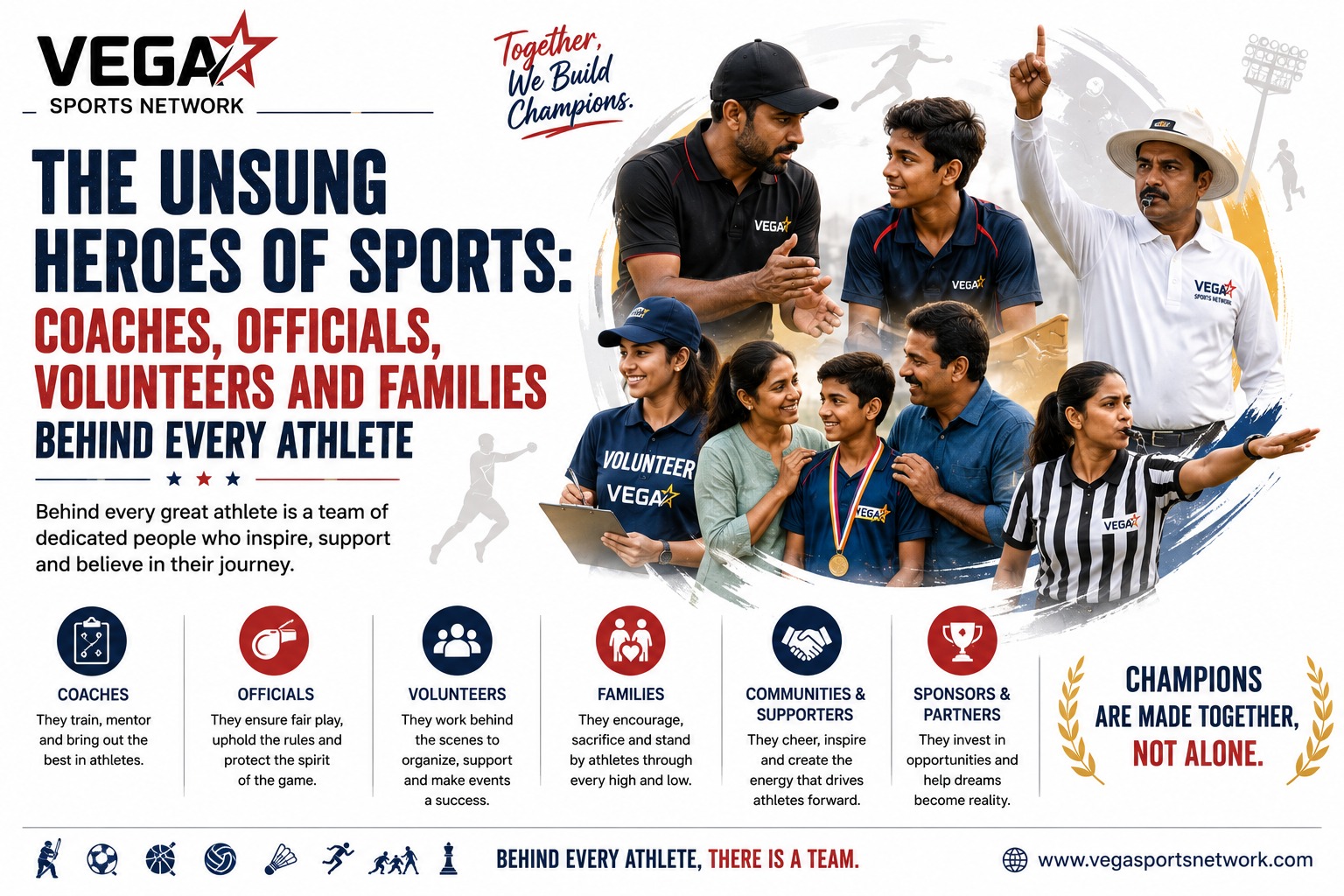
When an athlete lifts a championship trophy, the photograph usually captures one person holding it.
What the photograph rarely captures are the hundreds of hours contributed by the people standing behind that athlete.
Sporting success is almost never an individual achievement.
Behind every player are coaches who provide guidance, parents who make sacrifices, officials who ensure fair competition, volunteers who organize events, administrators who coordinate tournaments, and teammates who provide constant support.
These individuals are the invisible foundation of sport.
Coaches: The Architects Behind Athletes
A coach is often one of the most influential people in an athlete's sporting journey.
Great coaches do far more than teach technique.
They identify potential before others recognize it. They understand when athletes need encouragement and when they need discipline. They help players overcome poor performances and prepare them for important competitions.
Most importantly, coaches teach athletes how to improve.
A talented child may naturally perform well, but structured coaching helps transform natural ability into consistent performance.
Coaches also influence character.
Young athletes observe how coaches respond to victory, defeat, officials, opponents, and difficult situations.
For this reason, coaching is both a sporting and leadership responsibility.
Parents: The First Support System
Before most athletes ever meet a professional coach, their sporting journey begins with their family.
Parents drive children to early morning practices.
They wait through long training sessions.
They purchase equipment.
They travel to tournaments.
They celebrate victories and provide encouragement after disappointing performances.
Much of this happens quietly.
Parents often invest enormous amounts of time and energy without expecting recognition.
However, the healthiest role for parents is supportive rather than controlling.
Children should feel encouraged to participate because they enjoy sports—not because they fear disappointing their families.
Positive parental involvement can dramatically influence how long young athletes remain involved in sport.
Officials: Protecting Fair Competition
Referees, umpires, scorers, and technical officials rarely receive the appreciation they deserve.
Without them, organized sport simply cannot function.
Officials protect the integrity of competition by ensuring that rules are applied fairly and consistently.
Their decisions may not always please every player, coach, or spectator, but respect for officials is fundamental to sporting culture.
Young athletes must learn that disagreement is part of competition, but disrespect should never be.
Organizations also have a responsibility to provide trained officials and create environments where they can perform their roles without intimidation or abuse.
Volunteers: The People Who Make Events Possible
Community and grassroots sporting events depend heavily on volunteers.
Someone manages registrations.
Someone arranges equipment.
Someone coordinates teams.
Someone assists spectators.
Someone manages refreshments.
Someone helps with transportation.
Someone ensures that everything is ready before the first athlete arrives.
These responsibilities may appear small individually, but together they determine whether an event succeeds.
Volunteers create the infrastructure around competition that allows athletes to concentrate on playing.
Ground Staff and Support Teams
A good sporting experience also depends on people whom spectators may never notice.
Ground staff prepare playing surfaces.
Medical teams respond to injuries.
Fitness professionals help athletes prepare physically.
Photographers capture important moments.
Technology teams manage scoring and digital platforms.
Event coordinators ensure schedules remain organized.
Security teams protect participants and spectators.
Each person contributes to the overall experience.
Professional sport requires professional support.
Schools and Institutions
Educational institutions are another important part of the sporting ecosystem.
Schools often provide children with their first opportunity to discover sports.
A school ground may be where a future athlete first holds a cricket bat, kicks a football, plays badminton, enters a chess competition, or learns basketball.
When schools encourage sports alongside academics, students receive opportunities to develop physically, socially, and emotionally.
Institutional support can therefore influence an entire generation of athletes.
Sponsors and Businesses
Sport also requires financial sustainability.
Sponsors contribute resources that allow tournaments to improve infrastructure, provide equipment, create better experiences, and reach larger audiences.
Responsible sponsorship should create value for both sport and business.
When companies support grassroots sporting initiatives, their contribution can directly create opportunities for athletes who might otherwise never receive them.
Teammates: Growing Together
Perhaps the closest support system for any athlete is the team itself.
Teammates experience everything together.
They train together.
They travel together.
They win together.
They lose together.
They understand each other's struggles in ways that outsiders sometimes cannot.
These relationships often become lifelong friendships.
Recognizing Everyone Behind the Game
At Vega Sports Network, we believe sporting excellence should recognize the entire ecosystem behind the athlete.
Players may be at the center of competition, but successful sporting platforms require cooperation among coaches, parents, officials, institutions, volunteers, sponsors, administrators, and communities.
As sports continue to grow, appreciation for these contributors must grow with them.
A championship may belong to the athletes on the field, but the journey belongs to everyone who helped them get there.
The next time we celebrate a champion, we should also remember the coach who arrived early, the parent waiting outside practice, the official standing under the sun, the volunteer organizing registrations, and the countless people whose names may never appear on the scoreboard.
Champions may receive the medals, but behind every medal stands a team far bigger than the one on the field.